
// case-study · product build
Scheduling one meeting took 39 emails. Now it takes none.
TroikaBot is an AI assistant that arranges small-group meetings entirely over email — no app, no login, no account, for the organiser or any guest. We built it end to end, from the intake form to the calendar invite.
- Client
- TroikaBot
- Sector
- Professional networking
- Scope
- Full product, end to end
- Status
- Live, public beta
- Less time scheduling
- 60–80%
- Participants per meeting
- 2–10
- Accounts a guest needs
- 0
- Setup time
- 30s
TroikaBot's own published figure
organiser plus up to nine
no app, no login, no password
name it, paste emails, done
The challenge
The founder is an active ProVisors member. A troika — three professionals meeting to trade referrals and introductions — is a standard practice in networking groups like ProVisors, BNI, Vistage, EO and YPO. Arranging one is miserable.
He counted the emails it took to schedule a single three-person meeting. Thirty-nine. Not because anyone was being difficult, but because group scheduling by reply-all has a structural flaw: every participant receives every message, including the follow-ups and clarifications meant for somebody else. People answer the wrong question, or answer partially, or stop reading the thread entirely.
Scheduling tools already exist. None of them fit, because they all require the guests to adopt something — create an account, install an app, learn a booking page. For a networking meeting between people who have met once, that ask is fatal. The organiser will not impose it, so they fall back to email, and the thirty-nine messages happen again.
So the constraint that shaped the entire build: guests must do nothing they would not already do. They reply to an email in plain English. That is the whole interface.
The approach
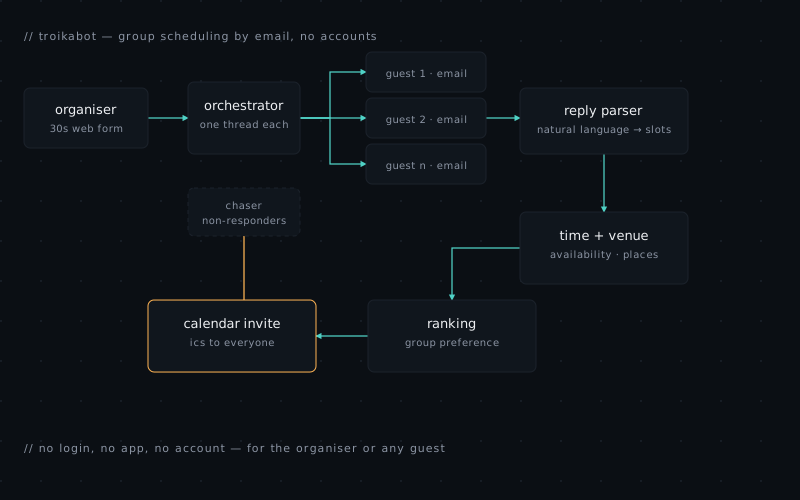
One thread per guest, never a group thread
This is the architectural decision everything else follows from. TroikaBot never puts participants on a shared thread. It opens a separate conversation with each person and acts as the hub between them.
The effect is that nobody sees noise meant for anyone else. Each guest is asked one clear question at a time and answers only for themselves. The organiser's inbox stays empty — they set the meeting up and hear nothing again until it is confirmed. Every thread carries a stable reference so replies, forwards and late responses all route back to the right meeting.
Guests write in plain English, not into a form
Replies arrive as ordinary prose — "Tuesday after 2 works, Thursday I'm out", "anywhere near the Mission is fine". An extraction layer turns that into structured availability and constraints. Ambiguity is not guessed at: if a reply cannot be resolved confidently, TroikaBot asks a narrower follow-up rather than assuming and booking something wrong.
Deciding where, not just when
Most schedulers stop at a time slot. For an in-person networking meeting the venue is half the problem, and it depends on where all the participants are coming from. TroikaBot proposes real venues near the group and puts them to the same ranked vote as the times, so both are settled in one pass rather than reopening the thread.
Ranked preferences, not first-come-first-served
Each guest ranks the candidate times and venues instead of picking one. A ranking works where a simple vote does not: it finds the option with the best group outcome rather than the one the fastest replier happened to choose, and it still resolves cleanly when no single slot suits everyone perfectly.
Chasing people is the product, not an afterthought
The reason group scheduling stalls is almost never disagreement — it is silence. Someone does not reply and the whole thing halts, because the organiser has to decide whether to nudge and feels rude doing it.
TroikaBot handles non-responders itself with timed, gentle follow-ups, and keeps the meeting moving. The organiser never chases anyone, which removes the social cost that makes people avoid organising these meetings at all.
The hard engineering here is not the scheduling. It is deliverability and state: every message must reach a stranger's inbox, and every reply must resolve back to the right meeting, guest and question — days later, possibly out of order.
Email as the runtime
When email is the interface, the transactional email pipeline stops being plumbing and becomes the product surface. Messages have to land in the inbox of someone who has never heard of the sender. Threading has to survive clients that mangle subjects, quote entire histories, or reply from a different address than the one invited. Late replies have to be reconciled against a meeting that may have already moved on.
Where it landed
TroikaBot is live and in public beta at troikabot.com, with a free tier and three paid plans, and works for groups from two to ten people. It targets exactly the audience it came from: ProVisors, BNI, Vistage, EO, YPO and YEC members, plus board and committee meetings.
TroikaBot publish the figure that the product saves organisers 60–80% of the time and effort of scheduling, and that they never chase a participant. The founder — still an active ProVisors member — uses it for his own troikas.
- Organiser sets up a meeting in about 30 seconds, then does nothing further
- Guests need no account, no app and no password — they reply to an email
- Times and venues are both resolved by ranked group preference in one pass
- Non-responders are followed up automatically, so meetings do not stall
- Calendar invites are issued to every participant on confirmation